Sustainable air-filtration

Sustainable air-filtration
Friendly Filtering Spider Plant---clippings of the hanging new generation can be planted to make more!

Statement

We are a design lab based in Joshua Tree, California. Our purpose is to:
1) Look at plants as technology but from a human and creative perspective
2) Pursue the potential many plant species have for removing toxins and adding moisture to the breathing zones in our homes, offices, clinical spaces, and commercial spaces.
3) Encourage the co-habitation of plants and humans.
4) Increase the appeal of incorporating plants into our living spaces by applying good, sustainable design principles to existing methods of keeping houseplants.
5) Personalize the breathing zones of individuals based on their environmental health concerns such as benzene or formaldehyde exposure.
6) Re-imagine the kitchen’s tea cupboard and spice rack as a living resource.
7) Re-imagine the bathroom’s medicine cabinet as a living resource offering safer, lasting, fresher, and more holistic alternatives to many of the commercial items that are conventionally stocked in medicine cabinets at home.
8) Critically engage the ways in which plants can be used for aesthetic purposes in interior design.


In this pursuit we are currently developing the following design lines:
“Sustainable Air Filtration”
“Sustainable Humidity Maintenance”
“Living Medical Resource”
“Living Kitchen Resource”
“Built-In and Mobile Terrarium Installations”
“Interior Desert-scaping”


Showing posts with label Moving to the Desert: An experiment in mobile living. Show all posts

Monday, October 20, 2008

White Sands, NM


This is not the beach. This is the desert. This is a radiated playland.

Most Commonly Said in New Mexico: "THIS IS SO BEAUTIFUL", "See any rattlesnakes?


Journey From East to West


HERES SOME CONTEXT: A month after I graduated college, I bought and modified a "weekender" camper van. As you can see, it is beautiful! Anna and I have been living in it since mid-July, winding our way from the east coast of Virginia, through Tennessee, Arkansas, and Texas. The van sat there for a while and I went to get my share of winter on a big family reunion cruise in Alaska. By that time, I had some sense of how campgrounds are used in this country and a sense of who lives in the south, what they do, and how they respond to people with Virginia liscense plates. When I came back from Alaska, I made that drive to Texas from Virginia again, but this time in 24 hours along the freeways of Georgia, Mississippi, Louisiana, and Texas. After some time in east texas, we moved on to Houston, Austin, and then through the no-where lands of West Texas where 6 hour drives between gas stations seemed pretty normal. Marfa, TX was a great respite where we finally saw some Obama signs and some public art. Crossing the border patrol checkpoints and narcotics checkpoints in Southwest TX snuggling the border of Mexico, we finally made it to New Mexico which was the first place we considered settling to make some money and stretch out in something a little bigger than the van. Greeted by a rainbow in Las Cruses which was much more sprawling than I anticipated. The desert was also much higher than I expected. From there to the AMAZING white sands, to the sweet town of Roswell, to Albuquerque, and Santa Fe. We spent another while in Santa Fe and Albuquerque in a friendly house for a while and camped out in the driveway of some friends. Tired yet? So was I. My sister's wedding in Virginia crept up on us and we left the van in the Albuquerque airport parking lot and got on a jet. After the wedding festivities, we took a Greyhound bus (missing the van very much) to NYC to reunite with our friends. It got cold. Really cold. I spent some time in the blistering winds on fire escapes. I got ready for the low desert of California.
Sunday, April 20, 2008

Project Updates


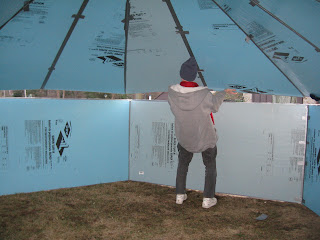
This table was made out of an extra triangle of insulation board. There is a wood support in the middle. It cannot hold much weight, but is a great design for the interior of the yurt because it maximizes table space without obscuring the wall space which will be covered shortly in drawings, typed posters of the future scenario, and image collages/montages.

These are developing Lion's Main mushrooms. THe moisture kept in the yurt creates an ideal growing condition for mushrooms. Once the first generation of mushrooms is harvested, the mycelium left in the bag will be used to remove toxins from soil used in the terrariums. What I am describing is a potentially closed-loop system of maintaining a toxin-free home environment. The worm compost creates soil which is treated by the mycelium (which produce consumeable mushrooms for food), the rainwater is collected in gutters made out of plastic-lined cardboard edges I salvaged from dumpsters that were once used as a packing material for photocopy machines, the rainwater is treated and detoxified by the aquatic and wetland plants, the water in turn is used on the mushrooms and terrarium plants, and the plant terrariums feed on this remediated soil and water---a process that perpetually and sustainably filter toxins out of the air. All of these steps are important parts of the environmental maintanance systems that improve environmental and human health today and are necessary for survival in the scenario for 2150.

Interior Construction and Live-In


Wednesday, April 9, 2008

mushroom incoulation for bioremediation


In order to inoculate mushrooms it seems you have to have a very clean environment for them. The spores that we used are warm-weather button mushrooms. After we have the inoculated cakes from the first part of the process we will use the spoil produced from the worm compost project. The mushrooms will remove toxins from the soil and will be a good source of food.

Part 1:
Materials
-12 1/2 pint jars
-8 cups of vermiculite
- 2 2/3 cups of brown rice flour
- 2 2/3 cups water
-perlite
-mushroom spores

Process:
1) mix the vermiculite, brown rice flour first, then add the water and stir the mixture (note: for more nutrients add a teaspoon or two of honey to boiling water)
2) in the bottom of each jar put a thin layer of perlite for drainage
3) fill the rest of the jar with the mixture that will be come the cakes out of which the mushrooms will grow
4) seal each of the jars and boil then for about an hour
5) after they have cooled, punch a hole in the lid of the jar on to sides and add the spores on the side of the mixture
6) secure a coffee filter on top of the jars and KEEP MOIST
7) cover the jars with a plastic bag to keep in moisture

Worm bin for compost


Yesterday we finally got the worms for our much anticipated worm compost system. In constructing the bin we used a rubbermaid bin we had lying around. To makes this we:

1) burnt holes in the very bottom of opposite sides of the bin and attached rubber tubing to drain the tea that the worms will eventually produce

2) Duct taped a fine mesh (fine enough to keep the worms out) about 4 inches above the bottom of the bin which allows for more oxygen to reach the composting material as well as creates an area for the tea to be collected (it is good for plants)

3) tore up thin strps of newspaper (enough to cover the mesh)

4) added enough coconut substrate to cover the newspaper

5) added compostable materials (mainly coffee grounds and tea bags so far) and the worms

Monday, February 11, 2008

The yurt is down...

The sun went away and the winds picked up. The yurt survived a brutal windstorm in the night and in the morning we made the tension ring stronger and put it back in place from where it had shifted on-site. Feeling the gusts pick up above 45 mph, we went to the hardware store for ropes and sandbags to tether it down using the surrounding low railing. Then there it was, haven been blown like a rocket several hundred feet and crashed into some evergreen trees. No witnesses came forward to tell of the spektacle: the silver hexagonal yurt hovering above the college art center--lifted like a true UFO.
The insulation boards, my body, and my wonderful shifting 'team' have now been tested under extreme weather conditions. I wrote a new set of laws tofollow for phase 2.


Saturday, February 9, 2008

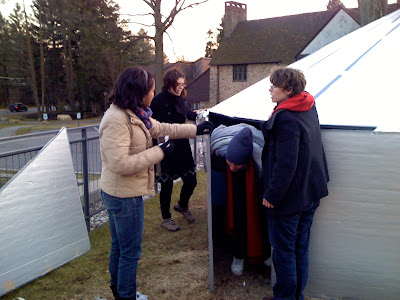
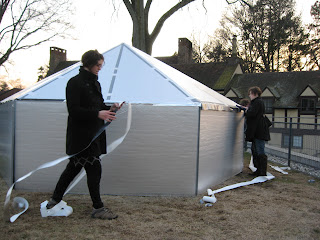
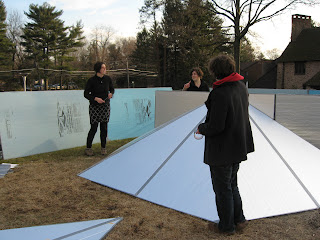
The yurt is up!

The hexayurt (made exlusively of Thermax insulation board, duct tape, and foil tape) has been constructed on the lawn of the arts center at Sarah Lawrence College in Bronxville, NY. It is already beginning to look like a a safe pod for a future inhabitant on the run from contaminated, unsafe areas. It is being tested under rain and snow for at least the next ten days.
You can be expecting to see pictures soon.

Coming up Soon:
1) The "Future Scenario" narrative based on extrapolations of the ways in which we do things today (social, political, and economic behavior patterns), technological development, and how the human body and everything else responds to human activities. The narrative is also based on imagery from dream and meditation and futurist novels, stories, comics, Manga, films, video games, and art.
2) Video: "Newsfeeds From the Future!"